Tabilet Memory Bank
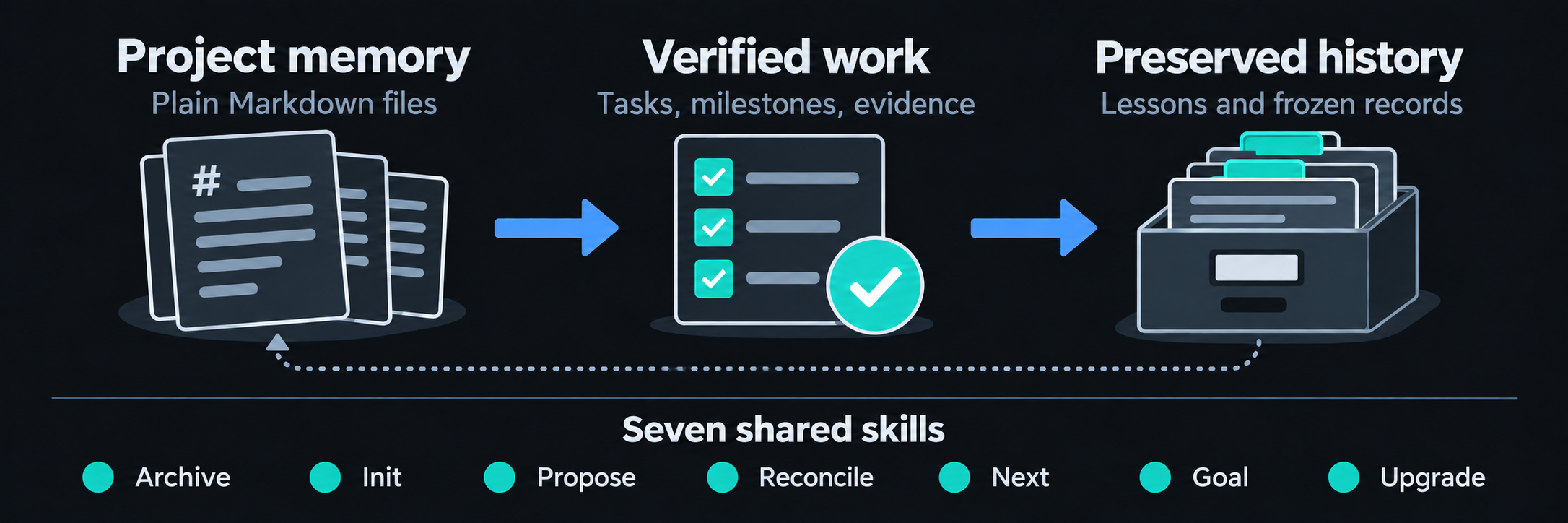
Keep your project's decisions, tasks, and verification evidence in plain Markdown. Memory Bank gives coding agents a shared record of what the project is, what has been done, and what should happen next—even when you start a new session or switch agents.
Use the same project files with Claude Code, Codex, agy (Antigravity), or DeepSeek Harness
(DSH). Seven optional skills help create and maintain them. The files stay in
your repository and remain usable without the skills. Version 2.0.0 keeps
project-owned Memory Bank files under tabilet/.
Install the skills Start your first project
The agent brings the capability. The project brings the memory.
Choose your starting point
| Your project today | Start here |
|---|---|
| New, or an existing codebase without a memory bank | Init inspects the project, asks about decisions, and proposes a plan. A broad codebase may need Archive first. |
| Already has approved tasks | Next handles one task; Goal handles an explicit milestone order. |
| Has a requested feature or candidate promotion | Propose inspects the current plan and presents one planning proposal. |
| Has a new engineering review | Reconcile checks the findings and proposes planning changes. |
| Has v1.5.0 files at the project root | Migrate to v2 before running v2 workflows. |
| Uses an older workflow contract after migration | Upgrade proposes rule changes while preserving tasks and history. |
These are entry points, not a sequence every project must follow. See worked examples for how they fit together.
What stays in your project
your-project/
├── AGENTS.md                 what an agent reads first
├── docs/                     other project documentation
└── tabilet/
    ├── GOAL.md               optional project addendum to the bundled goal protocol
    ├── memory-bank/
    │   ├── product.md         what this is, and is not
    │   ├── architecture.md    layout, data flow, boundaries
    │   ├── tech-stack.md      commands, dependencies, verification
    │   ├── lessons.md         learning that still applies
    │   ├── milestone.md       active milestones and acceptance
    │   └── status-M01.md      one file per active milestone
    ├── docs/history/          retired records; created when first needed
    └── evolution/             versioned direction snapshots
AGENTS.md tells an agent where to start. The memory bank holds current facts
and the active plan. History preserves evidence for later questions, and
tabilet/evolution/ records changes in direction. Status IDs remain permanent across
active and retired storage.
Reading and maintaining these files needs no Memory Bank runtime. Git is needed for the usual per-task commit workflow. Python is needed for the optional API runner and one-time migration; your existing agent can work with the files directly.
The seven skills
| Skill | When you reach for it |
|---|---|
| Archive | A broad existing package needs a commit-anchored map of what is already there. |
| Init | A project has no milestone and status harness yet. |
| Propose | A requested feature, candidate promotion, or future direction change needs approved planning. |
| Reconcile | A new code, architecture, or security review arrives. |
| Next | Implement or resume one task, verify it, and commit under the governing policy. |
| Goal | Execute ordered milestones with an explicit commit policy and completion condition. |
| Upgrade | You installed newer skills and want to adopt their rules safely. |
Init, Archive, Propose, Reconcile, and Upgrade present a complete proposal for approval before writing. Next and Goal execute work you have authorized; they can change code, update records, and make commits under the applicable policy. Installing a skill does not authorize work or migrate an existing project.
Suggested models
The skills do not require or select a particular language model. They run with the model chosen by the host agent, and their Markdown state stays portable across providers. Model capability still matters because each workflow has a different shape. The names below are current Codex examples, not names the skills recognize or require; Codex may rename or replace them, and other providers have their own model names.
| Work shape | Skills | Capability profile | Current Codex example |
|---|---|---|---|
| Open-ended discovery and planning | Init, Propose, Reconcile | Deep model with strong judgment | Sol with high reasoning |
| Bounded evidence, rule analysis, and combined implementation-review runs | Archive, Upgrade, Goal | Balanced model with strong reasoning and tool use | Terra with high reasoning |
| One explicit task from an approved plan | Next | Fast model for clear, repeatable work | Luna with high reasoning, followed by a manual balanced-model review such as Terra |
Choose the closest equivalent available in the host agent: a deeper model for ambiguous planning and high-consequence review, a balanced model for evidence-heavy analysis, and a fast model for clear tasks with explicit acceptance and verification. Escalate from Luna when a task exposes unclear dependencies, changes architecture, or repeatedly fails verification. Use Sol for release-critical, security-sensitive, or unusually broad final reviews.
A skill cannot change its parent session's model. In Codex, use /model or a
model profile before invoking the skill. Goal contains both implementation and
the bounded milestone review, so a balanced model such as Terra is the practical
default for the whole run. Next can use a fast model such as Luna for a clear
row and then receive a manual review from a balanced model such as Terra. If
that row will close its milestone and trigger the closing review inside Next,
use the balanced model for the Next run as well. Task state, review counters, and
acceptance evidence remain in the project files across a separate review
handoff.
Long-lived memory
In projects that have adopted the retirement rules, a milestone's complete
specification and status document retire into
tabilet/docs/history/status-<LANE><NN>.md. The identifier stays reserved, the record
freezes, and the active plan stops carrying it. Retirement follows verification,
the bounded review gate, knowledge consolidation, and downstream reconciliation.
Completed task markers alone do not prove milestone acceptance.
What remains close to the next task is lessons.md: curated learning with
evidence, such as a failure mode whose cause was easy to miss. Superseded
knowledge is preserved in an append-only journal rather than overwritten.
This memory survives a chat reset, an agent switch, or the end of a subscription, because it belongs to the repository rather than to a vendor.
A dashboard for DSH
The optional tabilet-skills companion adds a Memory Bank sidebar to DSH. Browse tasks, memory, recorded acceptance evidence, and history for the selected project, then prepare a skill request in the existing conversation. You review and send it yourself.
The dashboard reads your project files. It does not maintain a second task list or mark work complete. Installing the companion in a headless profile exposes all seven v2.0.0 skills without the Web interface.